
What is a pip in forex trading, and why does every trader talk about it? When you are introduced to the world of currency trading, the first jargon you will get to know is a pip. This word is used several times by many beginners who never really comprehend its meaning and its importance. The reality is simple: as long as you do not know about pips, you cannot know about profit, loss, or risk in forex trading.
I will provide a clear and practical explanation of what a pip is in the forex trading business, how it functions, the calculation of pip value, and why it forms the basis of risk management in this guide.
What is PIP in Forex Trading?
Pips are important since they enable traders to quantify and control their performance in trading. All things in the forex trading revolve around pips.
Pips help traders:
- Measure price movement
- Calculate profit and loss
- Set stop-loss levels
- Define take-profit targets
- Compare volatility between currency pairs
- Manage trading risk effectively
In the absence of knowledge of pips, the trading decisions will be unstructured. Pips introduce order and regularity in trading.
How Pips Work in Major Currency Pairs
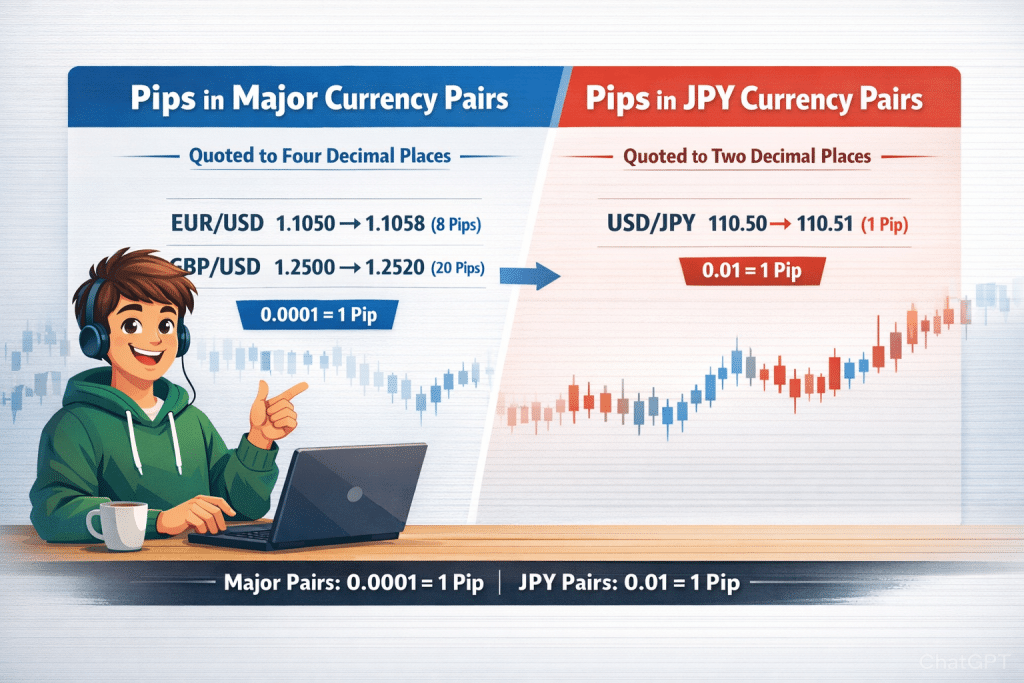
Most major currency pairs are quoted to four decimal places. In these pairs, the fourth decimal place represents one pip.
Examples of such pairs include:
- EUR/USD
- GBP/USD
- AUD/USD
- USD/CAD
Assuming that EUR/USD is no longer at 1.1050 but at 1.1058, then that is an 8-pip change. Equally, when GBP/USD is at 1.2500 and shifts to 1.2520, then it is a 20 pips gain.
Each change of 0.0001 represents one pip in these currency pairs.
Japanese Yen (JPY) Pairs
Japanese yen currency pairs are quoted differently. They normally have two decimal places instead of four decimal places.
- For example, if USD/JPY moves from 110.50 to 110.51, that represents one pip.
The second decimal place is defined as one pip in the JPY pairs. This distinction matters as the inexperienced tend to mix up the calculations of pip between common pairs and the JPY pairs.
What Is a Pipette in Forex?
Most of the forex brokers today provide pricing with more accuracy. You might see the exchange rates in five decimal points, i.e. 1.10507.
The fifth decimal point is referred to as a pipette.
One-tenth of a pip is referred to as a pipette. In simple terms:
- 1 pipette = 0.1 pip
- 10 pipettes = 1 pip
Pipettes enable brokers to give narrower spreads and precise pricing. Nevertheless, the traders are not to forget that the standard unit of measure remains a full pip.
How to Calculate Pip Value in Forex Trading
The concept of pip value is important to risk management. A pip value is dependent on three primary factors:
- The currency pair
- The lot size
- The exchange rate
Let’s simplify this with practical explanations.
Standard Lot
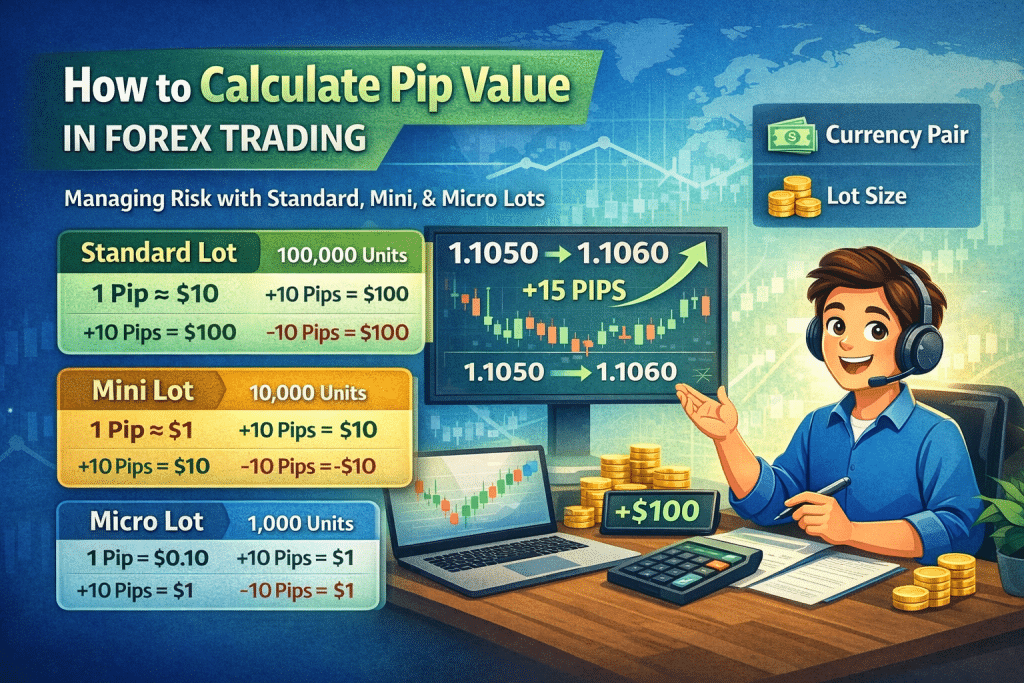
One unit of base currency is 100,000 units of the standard lot. A single pip is close to 10 dollars in the trade of a typical lot in most currency pairs, which are priced in USD.
When the market trades 10 pips in your favor you get an approximate of 100 dollars. When it shifts 10 pips against you, you will have lost approximately 100 dollars.
Mini Lot
A micro lot equals 1,000 units. In this case, a single pip is almost equal to a dollar decade.
Each 10-pip price change would bring about a 10-dollar gain or loss.
Micro Lot
A micro lot equals 1,000 units. Here, one pip is approximately equal to $0.10.
- A 10-pip move would result in a $1 gain or loss.
This basic analysis assists novice traders in comprehending the dynamics of pipeline value depending on the size of the position.
How Pips Affect Profit and Loss
All the trade results are expressed in pips, which are then converted into money according to the lot size.
Take the example of you purchasing EUR /USD at 1.1000 and closing the trade at 1.1020. That is a 20-pip profit.
If you traded:
- A regular lot, you win about two hundred dollars.
- A mini lot, you earn about $20
- A micro lot, you earn about $2
Imagine that the market is going against you by 50 pips when you are trading a typical lot. That would result in a $500 loss.
This shows why risk management in a trade involves having knowledge of the pip value prior to entering into a trade.
What Is Spread in Pips?
The trading cost that is billed by the broker is the spread. Reduced spreads mean that trading costs are lower, particularly to those traders who make short-term trades like scalpers.
For example:
Bid: 1.1000
Ask: 1.1002
The spread equals 2 pips.
The trading cost that is billed by the broker is the spread. Reduced spreads mean that trading costs are lower, particularly to those traders who make short-term trades like scalpers.
How Many Pips Do Currency Pairs Move Daily?
The average daily ranges of the currency pairs vary. Typically, on normal market conditions, major pairs like EUR/USD, GBP/USD and USD/JPY usually experience a range of 50-150 pips per day.
When economic news is of high impact, the price may move more than 200 pips in a single trading session.
Knowing the average daily pip range helps traders:
- Set realistic take-profit levels
- Adjust stop-loss distances
- Understand market volatility
How Professional Traders Use Pips for Risk Management
Professional traders think in pipes first and then in money. Such an attitude assists them in retaining emotional control.
For example, a trader may decide:
- Risk per trade: 25 pips
- Reward target: 50 pips
This creates a 1:2 risk-to-reward ratio.
They compute the lot size before they venture into the trade, depending on the pip risk and the size of the accounts. This methodology is systematic and ensures that there is no overleveraging and safeguarding of capital in the long run.
Common Beginner Mistakes About Pips
The pips have been misinterpreted or misused by many new traders. These are some of the pitfalls to be avoided.
Ignoring Lot Size
One 10pip shift is not necessarily an equivalent dollar move. This will be determined by the lot size.
Confusing Pip and Pipette
Some beginners mistake a pipette (0.00001) for a full pip. This leads to incorrect calculations.
Not Calculating Risk in Pips
Trading in trades without setting the stop-loss in pips makes one risk a lot.
Overleveraging
High leverage amplifies the effect of pipes, and even minor price changes are perilous.
Ignoring Spread
The dissemination decreases your original profit. Always put in trade planning.
Frequently Asked Questions About Pips
What is 1 pip worth in forex?
In the majority of the pairs involving USD, a one-pip change in most currency pairs would be around $10 with the help of a standard lot.
How much is 10 pips?
It depends on lot size. One pipp will be approximately 100 dollars on a standard lot. For a mini lot, it equals $10. For a micro lot, it equals $1.
What is 100 pips equal to?
On a standard lot, 100 pips are around a thousand dollars.
Do all currency pairs use four decimal places?
No. Japanese yen pairs use two decimal places for pip calculation.
What is the difference between pip and point?
One unit of the price movement is a pip. A point can occasionally be a pipette, according to the language of brokers.
Read Also: Avoid Losing Your UAE Gratuity: 9 Flaws That Trigger Denial
Final Thoughts
Pips are used to measure all the movements in the forex market. They define profit, loss, risk and strategy. Whichever the size of your trading, be it having micro lots or the normal lots, pips are the language of forex.
If you truly understand pips:
- You trade with clarity
- You manage risk intelligently
- You avoid beginner mistakes
- You make structured decisions
Master pips first. Then focus on strategy.


