

Ever wondered how there are oils that perform well in high temperatures and fail in low temperatures? The trick to a smooth engine and machinery operation is in knowing the distinction between viscosity and viscosity index (VI). Simply put, viscosity is the factor that determines how thick or thin a fluid is, whereas viscosity index informs you of how stable the thickness is at different temperatures.
In this article, I’ll break down viscosity vs viscosity index, the meaning of viscosity index, and its significance in selecting the appropriate lubricants in this article.
What is Viscosity?
The viscosity is a measurement of the resistance to flow of a fluid. Simply put, it informs us about the thickness or thinness of a liquid. The example is that honey is more viscous compared to water, which is free-flowing. Viscosity has significant importance in engineering and the automobile industries as it defines the ability of a lubricant to protect moving components.
Types of Viscosity
- Dynamic Viscosity: This is used to measure the internal resistance that a fluid has to motion. Units: Pascal-seconds.
- Kinematic Viscosity: The viscosity is given with respect to density. Units: centistokes (cSt).
Why Viscosity Matters
Viscosity is not simply a technical word, but it has a direct impact on:
- Engine efficiency: Excessively thick oil can result in the use of a lot of fuel, whereas excessively thin oil can result in a failure to protect engine components.
- Machinery longevity: Correct viscosity maintains fluid flow of pumps, turbines, and compressors.
- Every day fluids: Viscosity has an impact on the work of even water, paint, or motor oils.

What is Viscosity Index (VI)?
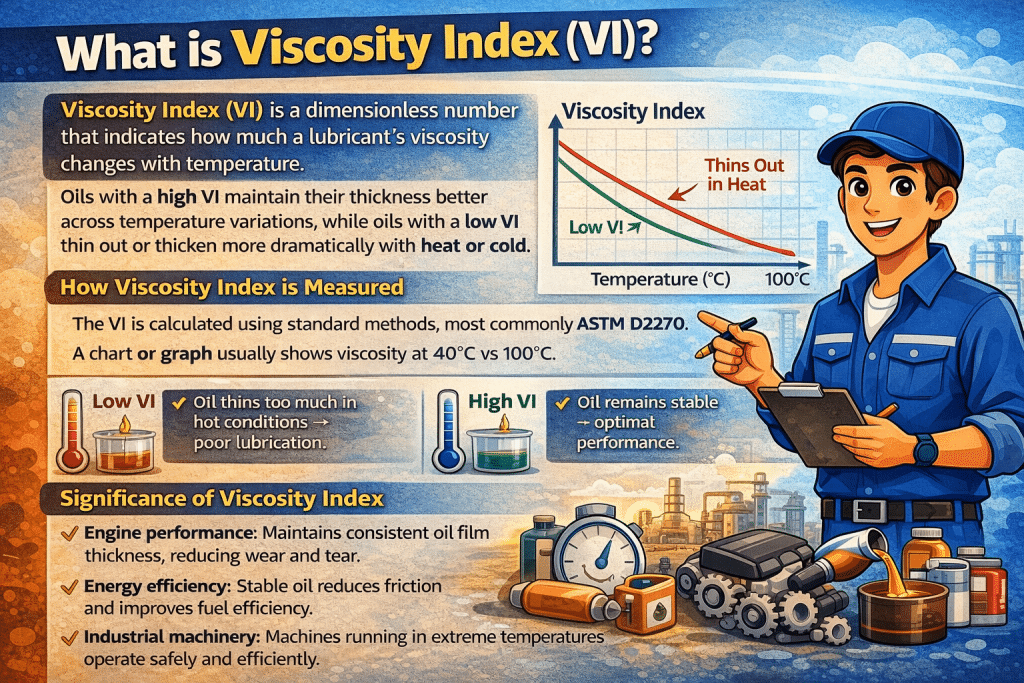
Viscosity Index (VI) is a dimensionless value that shows the rate of change of the viscosity of the lubricant with temperature. The higher the VI of the oil in its viscosity, the more it will retain its thickness over the temperature conditions, whereas the lower the VI of the oil, the more it will thin or visibly alter its thickness when hot or cold.
How Viscosity Index is Measured
The VI is calculated using standard methods, most commonly ASTM D2270. A graph or chart typically displays viscosity at 40 deg C versus 100 deg C.
Example:
- Low VI: Oil is too thin in high temperatures – lacks lubrication.
- High VI: Oil is stable – optimum performance.
Significance of Viscosity Index
- Engine performance: Maintains consistent oil film thickness, reducing wear and tear.
- Energy efficiency: Stable oil reduces friction and improves fuel efficiency.
- Industrial machinery: Machines that are used in excessive temperatures are used safely and efficiently.
Viscosity vs Viscosity Index
Key Differences
| Feature | Viscosity | Viscosity Index (VI) |
|---|---|---|
| Meaning | Resistance to flow | Change of viscosity with temperature |
| Unit | Pa·s or cSt | Dimensionless number |
| Function | Determines thickness | Indicates stability across temperature changes |
| Example | Honey vs Water | Engine oils performing in cold and hot weather |
Why Both Are Important
Both viscosity and VI are critical for lubricant selection. Viscosity and VI are both essential in the selection of a lubricant. Viscosity provides you with the behaviour at a particular temperature, whereas VI informs you of how it will behave under changes in temperature.
Practical Applications of Viscosity Index
Automotive Industry
- Engine oils: High VI oils are used when a car is used in areas that experience extreme temperatures.
- Gear oils & transmission fluids: Do not lose performance under heavy load and heat.
Industrial & Machinery
- Hydraulic oils: VI oils are required in machines such as excavators and cranes to work effectively.
- Turbines & compressors: The constant viscosity provides constant working conditions under different temperature conditions.
How to Choose Lubricants Based on Viscosity Index
- Check the VI rating before purchasing oils. Extreme climates are better served with increased VI.
- Take into consideration engine or machine type: The engines of modern engines usually demand multi-grade oils of high VI.
- Adhere to the recommendations of the manufacturer: They will offer the best VI ranges in various machines.
- Observe temperature conditions: Winters and hot seasons may severely affect the performance of the oil.
The example is a car in Alaska will require an oil that remains thin at low temperatures but does not become thin during warm weather.
Common Misconceptions
- High viscosity always means better protection – False. Thick oil may hinder flow and fuel efficiency.
- Viscosity index is the same as viscosity – False. VI is about stability across temperature, not actual thickness.
- Single-grade oils perform equally in all climates – False. Multi-grade oils with proper VI are preferred for variable temperatures.
Frequently Asked Question
What is the meaning of a high viscosity index?
High VI oils are consistently lubricated and protect at a consistent rate of viscosity between temperatures.
Does viscosity decrease in high temperatures?
Yes, the majority of the oils become thinner with an increase in temperature. IV defines the extent of thinning.
How is viscosity index different from viscosity?
Viscosity is used to determine the thickness of the fluids at a specific temperature, and VI is used to determine the stability of the fluids at various temperatures.
Which oils have high VI?
Modern multi-grade engine oils, synthetic oils, and specially formulated industrial lubricants usually have higher VI.
Read Also: Gratuity & CTC: What % of Salary Gets Deducted?
Final WOrds
Knowledge of viscosity and viscosity index is important to anyone who works with lubricants, be it in an engine or a machine in the industry. Whereas viscosity gives you the information on the thickness of a fluid, viscosity index gives you information on how a fluid can retain its thickness when it is subject to changes in temperature. Choosing the right combination ensures:
- Better engine and machinery performance
- Longer lifespan of parts
- Higher energy efficiency
Next time you select engine oil or industrial lubricant, check the VI rating—it could save you costly repairs and ensure smoother operation!
