Do you know what you are expected to pay in terms of Zakat in the UAE this year? It is an aspect that not a lot of people can do the right calculation, and this can lead to either an underpayment or an overpayment. Zakats are not a new law; they are a cleansing of the money and helping the needy.
Quick tool: To work out your zakat step by step, use our UAE zakat calculator.
This guide will explain the meaning of Zakat, who is required to pay it, how to calculate it in the UAE, and the most preferred ways of paying it. And, not only that, we will guide you on how to use a Zakat calculator to get the right results, and that is why it has become simpler than ever to complete this vital requirement.
What is Zakat?
One of the five pillars of Islam is Zakat, which is a form of charity given by Muslims on certain wealth. The qualified Muslims have to donate a part of their savings and assets to the needy, with the majority of the wealth subject to offering 2.5 percent of the yearly wealth.
Importance of Zakat
Zakat has both spiritual and social significance:
- Spiritual Cleaning: It cleanses wealth and teaches Muslims to spend their resources wisely.
- Social Responsibility: It relieves poverty and helps the poor, needy, and vulnerable.
- Community Development: Assists in the health of the society and increases equality.

Who Should Pay Zakat in the UAE?
Eligibility Criteria
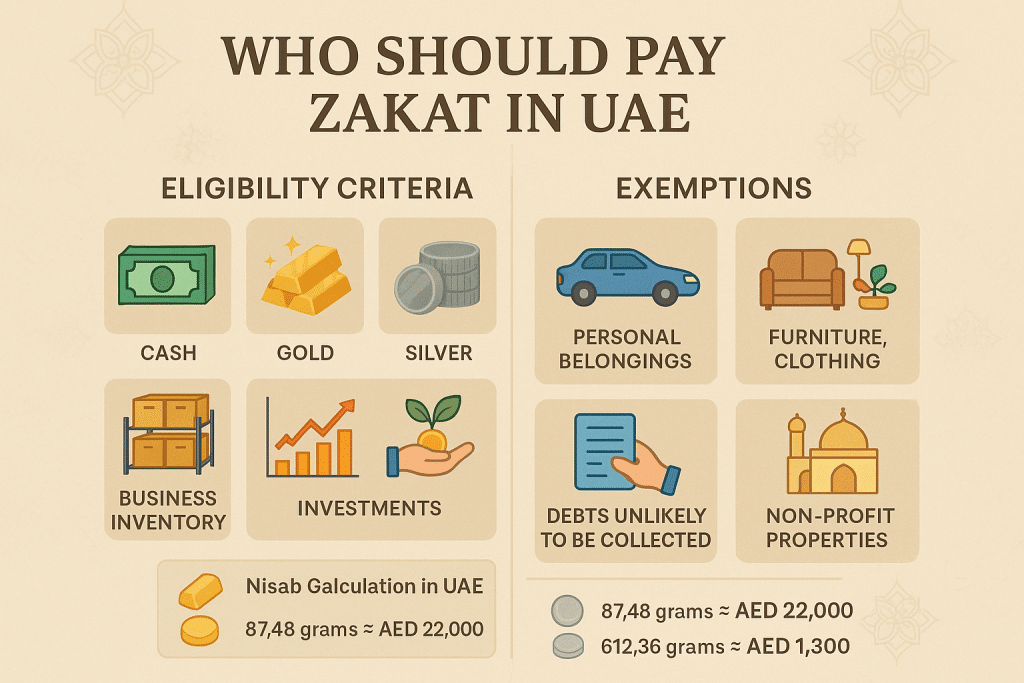
Not all people have to pay Zakat. The qualification is based on Nisab, which is the minimum value of wealth one possesses before Zakat is compulsory. The assets that attract Zakat are:
- Cash and savings
- Gold and silver
- Business inventory
- Shares, stocks, and investments.
- Other types of wealth that extend to Nisab.
Exemptions
You do not pay Zakat on:
- Individual property (motor cars, home furnishings, personal apparel, etc.)
- Debts due to you which are not likely to be recouped.
- Assets or properties that are not aimed at making profits.
Nisab Calculation in the UAE
The market value now of Nisab is:
- Gold: 87.48 grams
- Silver: 612.36 grams
Nisab moves with metal prices, so the AED figure changes every day. As a guide, with 24K gold at about AED 516 a gram in late September 2026:
- Gold nisab ≈ AED 44,000 to 45,000 (85 to 87.48 g, depending on the scholarly view you follow)
- Silver nisab is much lower: multiply today’s silver price per gram by 595 to 612.36 g
In case you have more than the Nisab in total assets, Zakat is mandatory.
Read Also: Zakat Nisab in the UAE: Gold and Silver Thresholds Explained
How to Calculate Zakat in the UAE
Step-by-Step Manual Calculation
It is easy to calculate the Zakat provided that you consider the following steps:
- List All Zakatable Assets
- Included cash, gold, silver, investment, and business inventory.
- Deduct Debts and Liabilities
- Debts, which are to be paid in the same year, must be subtracted.
- Compare with Nisab
- Zakat is obligatory in case of your total wealth is more than Nisab.
- Apply the Zakat Rate
- Most types of wealth have a 2.5 percent amount of total eligible assets.
Zakat Calculation Example
Suppose that you have the following assets in the UAE:
- Cash savings: AED 50,000
- Gold: AED 15,000
- Silver: AED 2,000
Total assets = AED 67,000
Nisab (gold standard) ≈ AED 45,000 → Eligible for Zakat
Zakat = 2.5% of 67,000 = AED 1,675
Using an Online Zakat Calculator
For greater accuracy and speed, you can use our Zakat Calculator UAE, which automatically calculates your Zakat based on current Nisab rates and the type of assets.
This tool is particularly useful in the event that you are dealing with a variety of types of assets or wish to eliminate the possibility of errors in the manual calculation process.
Zakat Payment in the UAE
How to Pay Zakat in the UAE
You can pay Zakat through:
- Islamic banks that are authorized and that offer the service of Zakat payments.
- Donation institutions accepted in the UAE.
- Online platforms such as our Zakat Calculator, which also guides you on where to pay.
Best Practices for Paying Zakat
- Time: The vast majority of people pay one year, normally in accordance with their lunar (Hijra) year.
- Recipients: Ensure Zakat reaches eligible individuals or organizations.
- Documentation: Keep records of payments for personal tracking and verification.
Common Zakat Mistakes to Avoid
- Incorrect Nisab calculation: Ensure you use the latest market value.
- Forgetting certain assets: Include gold, silver, stocks, and business inventory.
- Paying to unverified recipients: Always choose trusted charities.
- Late payments: Try to pay Zakat promptly after your lunar year ends.
FAQs about Zakat in the UAE
Q1: What is the Zakat rate?
- The normal rate is 2.5 per cent of the assets eligible.
Q2: Can I pay Zakat online in the UAE?
- Yes, there are a few online portals and bank sites where it is possible to pay safe Zakat. The Zakat Calculator UAE is convenient to use.
Q3: Do expats have to pay Zakat in the UAE?
- Muslims must pay the Nisab standards only, and irrespective of nationality.
Q4: Do I need to pay Zakat on business income?
- Yes, in case the assets of the business exceed Nisab, Zakat is due.
Q5: How often should Zakat be paid?
- Once a lunar year on the riches you have 12 months.
Read more: How to Calculate DBR in the UAE
Final Words
Zakat is not only a money tax, but it is also a method to clean up your fortune and feed the poor. The calculation of it is a sure way of accomplishing this crucial block of Islam.
So, whether you need to do it manually or make the picture simple, our Zakat Calculator UAE is the right tool to help you figure out exactly how much you owe in Zakat.


